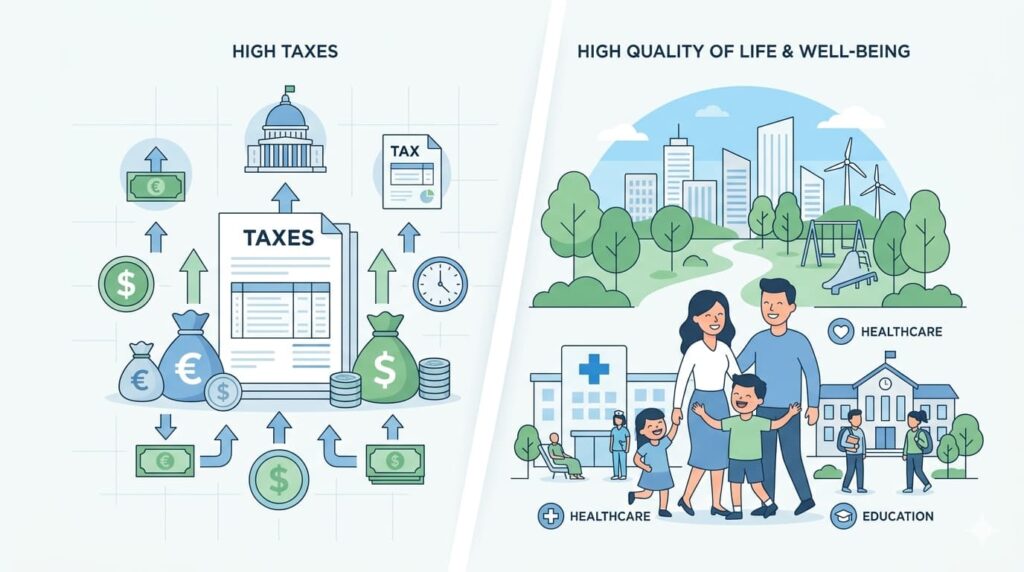
At first glance, it seems unfair. In countries like the United States, Germany, or Sweden, people hand over a large share of their income—sometimes more than 40%—to the government. Compare that to India, where tax rates are lower, and you’d expect people abroad to be frustrated. Yet the opposite is true. Citizens in these nations consistently report higher happiness, stronger trust in government, and better quality of life.
This article explains why rich countries tax more and still remain happy.
So, what’s really happening? Why do people in rich countries accept higher taxes—and still remain happy? Let’s explore this deeply and understand the psychology, economics, and social realities behind it.
Understanding the Reality of High Taxes
When we hear “high taxes,” we often imagine money disappearing from our pockets. But in developed countries, taxation is not just about collection—it’s about redistribution and public value. People aren’t simply losing money; they’re exchanging it for services, security, and stability.
Tax systems are usually progressive, meaning those who earn more contribute more, while lower‑income groups pay less or receive benefits. This reduces inequality and ensures a basic standard of living for everyone. The result? A sense of fairness. People feel the system is designed to protect them, not exploit them.
What Do People Get in Return?
The biggest reason people tolerate high taxes is simple: they see clear benefits in return. Let’s look at some of the most important ones.
1. Free or Affordable Healthcare
In countries like the UK, Canada, and much of Europe, healthcare is either free or heavily subsidized. Families don’t live in fear of hospital bills wiping out their savings. This alone removes enormous stress. Imagine never worrying about whether you can afford a surgery or a life‑saving medicine—that peace of mind is invaluable.
2. Quality Education for All
Education is another major benefit funded by taxes. From primary school to university, many developed countries provide high‑quality, accessible education. Student loans may exist, but repayment terms are often flexible. This means young people can build careers without being crushed by debt early in life.
Parents feel confident their children will have opportunities, regardless of income. In India, by contrast, many families spend heavily on private schools and coaching centers, often stretching their budgets thin. In high‑tax countries, education is seen as a right, not a privilege.
3. Strong Social Security Systems
One defining feature of developed economies is their safety net. Lose a job? You get unemployment benefits. Retire? You receive pensions. Unable to work due to illness or disability? The government provides support. This creates security. People aren’t constantly worried about “what if something goes wrong?” That peace of mind translates directly into happiness.
4. Excellent Public Infrastructure
From smooth roads and efficient public transport to clean water and reliable electricity, tax money is visibly used to improve daily life. Cities are better planned, public spaces are maintained, and government services are digitized and efficient. When people see their taxes working around them, satisfaction rises. They feel their money is well spent.
Trust in Government Makes a Big Difference
Another key factor is trust. In many developed countries, citizens believe their government will use tax money responsibly. Transparency, accountability, and strict regulations reduce corruption. People think: “My tax money is being used for my benefit and society’s improvement.” That mindset changes everything.
In contrast, where corruption is high or public services are poor, people feel their taxes are wasted. This leads to frustration and resistance toward taxation. Trust is the invisible glue that makes high taxes acceptable.
Lower Income Inequality
High taxes often help reduce the gap between rich and poor. Welfare programs, subsidies, and public services ensure even lower‑income groups have access to healthcare, education, and housing. This reduces social tension and creates balance. When inequality is lower, crime rates often drop, and overall life satisfaction increases. People feel society is fairer, which boosts happiness.
Work-Life Balance and Quality of Life
Happiness isn’t just about money—it’s about lifestyle. Many developed countries offer:
- Paid vacations
- Maternity and paternity leave
- Limited working hours
- Strong labor laws
Even though taxes are high, people enjoy more personal time, better mental health, and healthier lifestyles. This balance contributes significantly to happiness. A parent in Sweden can take months of paid leave to care for a newborn, while in India many families struggle with unpaid leave or job insecurity.
Economic Stability and Predictability
High‑tax economies are often more stable. Governments have resources to manage crises, support industries, and stabilize the economy during downturns. For example, during global recessions, developed countries can quickly provide relief packages, subsidies, and unemployment support. This stability gives people confidence about their future.
The Psychological Factor: Value Perception
One fascinating aspect is how people perceive taxes. In developed countries, taxes are often seen as a contribution rather than a loss. Citizens feel they are contributing to better roads, safer communities, stronger education systems, and healthcare for all. This sense of collective responsibility creates social cohesion. People feel part of something bigger than themselves.
India vs Developed Countries Comparison
| Factor | India | Developed Countries |
|---|---|---|
| Healthcare | Mostly Private | Free/Subsidized |
| Education | Mixed Quality | High Quality |
| Social Security | Limited | Strong |
| Public Infrastructure | Developing | Advanced |
What About Developing Countries Like India?
In India, the situation is different. Tax rates may be lower, but public services are inconsistent. Families often spend extra on private healthcare and education. Social security systems are limited, and infrastructure varies widely. As a result, people feel they are paying taxes and spending extra on basic needs. This creates dissatisfaction.
However, things are changing. With digital reforms, infrastructure development, and policy improvements, India is gradually building stronger public systems. Over time, better utilization of tax revenue can increase trust and satisfaction. The journey is long, but progress is visible.
The Real Truth: It’s Not About High Taxes
The key takeaway is simple: people aren’t happy because taxes are high. They’re happy because they receive value for what they pay. High taxes work only when services are reliable, systems are transparent, benefits are visible, and society feels fair. Without these, even low taxes can feel like a burden.
Final Thoughts
The idea that “higher taxes lead to unhappiness” is a myth. In reality, happiness depends on governance and public services. Developed countries have built systems where taxes are effectively converted into welfare, security, and opportunities. This creates trust, satisfaction, and overall happiness.
For countries like India, the focus should not just be on tax rates, but on improving how tax money is utilized. Because at the end of the day, people are willing to pay more—as long as they feel it is worth it. The lesson is clear: it’s not the percentage of tax that matters, but the value people see in return.
Frequently Asked Questions
Do higher taxes always lead to better quality of life?
No. Higher taxes improve quality of life only when governments use them efficiently for public services.
Why are people in developed countries happier despite high taxes?
Because they receive strong benefits like healthcare, education, and social security in return.
Is India moving toward a similar system?
India is gradually improving infrastructure and public systems, but it is still developing compared to high-income countries.
Author: Fiscal Guider Team
We publish finance, economy, and global comparison insights to help readers make informed decisions.